
Categories
Market UpdatesPublished August 27, 2026
Where the Market Stands: Commercial and Residential Real Estate, August 2026

Where the Market Stands: Commercial and Residential Real Estate, August 2026
Rise Above Realty, LLC — Edmond, Oklahoma
Every August, clients ask me some version of the same question: is it a good time to buy, sell, or sit tight? This year the honest answer is that it depends more on your specific asset and your timeline than it has in a long while. The national headlines are painting with a very broad brush, and the brush doesn't fit Oklahoma particularly well.
Here's where things actually stand heading into the fall.
Interest Rates: The Thing Driving Everything Else
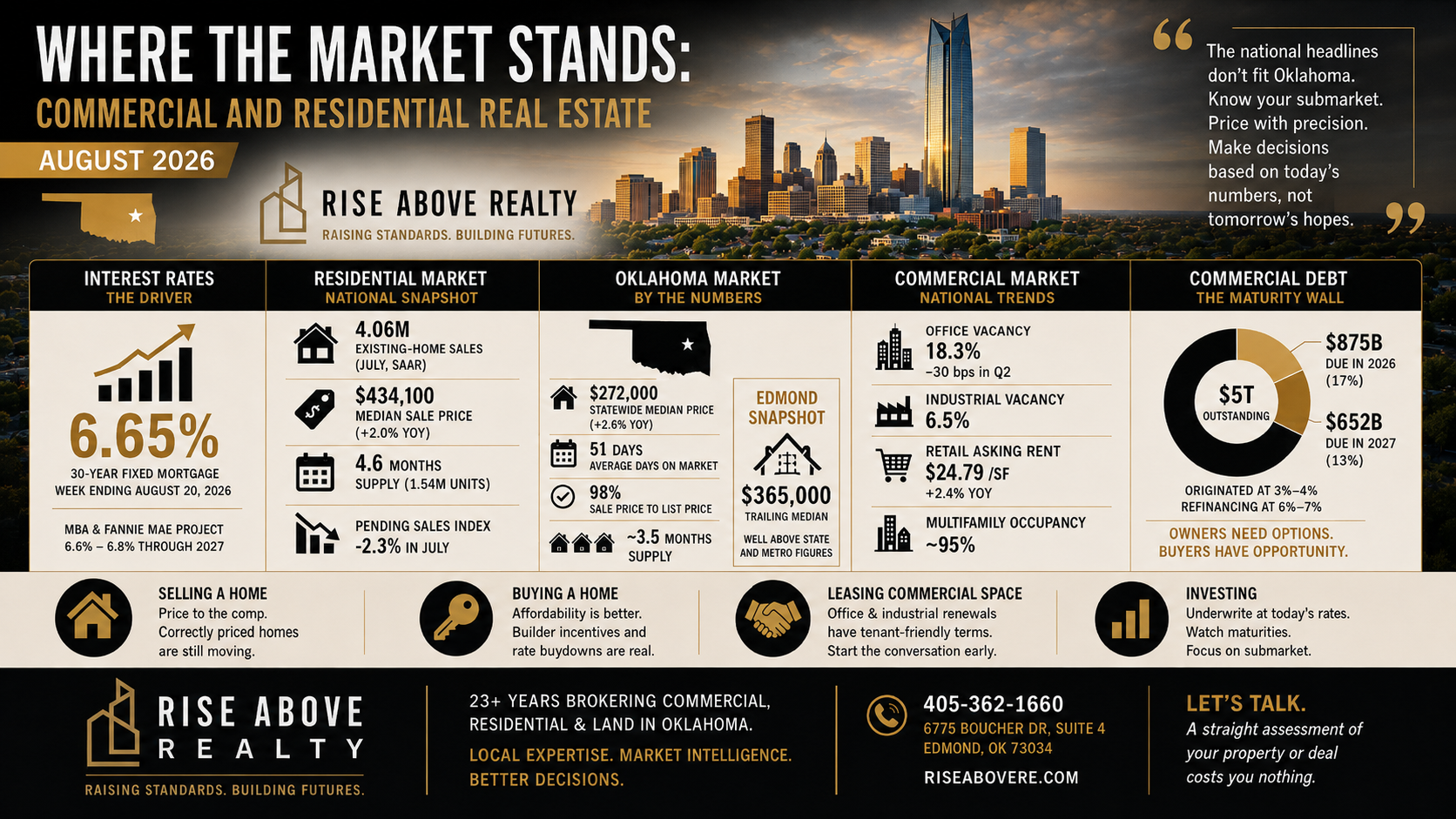
Mortgage rates dipped to about 5.98% back in February, and a lot of people took that as the beginning of a trend. It wasn't. Rates climbed through the spring and summer, hit their 2026 high in early August, and have settled in the mid-6s. Freddie Mac's weekly survey put the 30-year fixed at 6.65% for the week ending August 20 — up slightly from 6.58% a year ago.
The Federal Reserve held its benchmark rate steady at 3.50%–3.75% at the July meeting, but the vote was 9–3, and all three dissenters wanted to raise rates, not cut them. That's a meaningful shift in tone. Inflation is still running above the Fed's 2% target, and energy prices tied to the disruption in the Strait of Hormuz have made the picture worse. The next Fed meeting is September 15–16, and a hike is genuinely on the table.
The practical takeaway: stop underwriting deals assuming cheaper money is coming. The Mortgage Bankers Association and Fannie Mae both project 30-year rates staying in the 6.6%–6.8% range through the end of 2026 and into 2027. If a deal works at today's numbers, it's a deal. If it only works at 5.5%, it isn't a deal — it's a hope.
Residential: Stable Volume, Stubborn Affordability
The national resale market has been remarkably steady given the rate environment. July existing-home sales came in at a 4.06 million annualized pace, down 1.7% from June but up 0.7% from a year ago, with year-to-date sales running 2.4% ahead of 2025. The national median price rose 2.0% to $434,100 — the 37th consecutive month of year-over-year gains.
Inventory is the constraint that hasn't broken. Total supply sat at 1.54 million units in July, a 4.6-month supply, essentially unchanged from a year ago. Six months is generally considered balanced, so the national market still tilts toward sellers, just less severely than in 2021–2022.
Two soft spots worth watching:
Pending sales are slipping. The Pending Home Sales Index fell 2.3% in July to its lowest reading since January, with all four regions declining. Pendings lead closings by 30 to 60 days, so expect softer September and October numbers.
New construction is pulling back hard. July housing starts dropped 12.4% from June and 13.5% year over year. Builder confidence has been stuck below 40 for fifteen straight months. Builders are buying down rates and cutting prices to move standing inventory — the median new-home price fell to $393,800 in July, a five-year low. For the first time in a long while, new construction is competing with resale on price, not just on finishes.
The Oklahoma Picture Looks Different
This is where the national narrative stops being useful.
Statewide, Oklahoma's median sale price is running around $272,000, up roughly 2.6% year over year, with homes averaging about 51 days on market and closing near 98% of list. Supply is tighter here than nationally, at roughly three and a half months. We never got the pandemic-era price spike that Boise or Austin got, so we're not giving anything back now.
The metro splits sharply by submarket. Oklahoma City and Tulsa proper both close below the statewide median. This is the opposite of the pattern in most states, where the core city is the expensive part. Here, the premium sits in the suburbs. Edmond's trailing median has been running around $365,000, well above the state and metro figures. If you own in Edmond, Deer Creek, or the Kilpatrick corridor, you are in a fundamentally different market than someone selling in south OKC, and pricing strategy should reflect that.
Oklahoma's broader economy is also getting a tailwind the coasts aren't. Crude prices climbed above $100 per barrel this spring for the first time since 2022, and gross production tax collections have been strong. Worth a caveat: the Kansas City Fed has pointed out that high oil prices don't translate into Oklahoma jobs the way they did fifteen years ago. Capital discipline and drilling productivity mean producers are banking cash rather than hiring crews. Expect the revenue benefit more than the employment benefit.
Commercial: The Recovery Is Real, but It's Selective
The commercial story nationally has genuinely improved, and office is the surprise.
Office vacancy fell 30 basis points in Q2 to 18.3%. The largest quarterly decline since 2015. Prime vacancy dropped to 12.3%. The mechanism isn't a demand boom; it's a supply drought. Only 2.2 million square feet of office completed in Q2, contributing to the lowest first-half delivery total since tracking began in 1990, and the construction pipeline is down 87% from its 2020 peak. Asking rents rose 2.6% year over year, the fastest pace in six years.
Industrial vacancy fell to 6.5% as big-box demand and renewals firmed up leasing.
Retail is quietly the tightest sector in the country. National asking rents hit $24.79 per square foot in Q2, up 2.4%, on genuinely constrained supply. Almost nobody is building speculative shopping centers.
Multifamily absorption outpaced completions for the second straight quarter, with all 69 tracked markets posting gains.
Locally, Oklahoma City is following the same supply-driven script. Metro industrial vacancy is around 6.6%, with only about 560,000 square feet in the pipeline, meaning the current speculative product should get absorbed rather than pile up. Multifamily occupancy was around 95% earlier this year. Office is the outlier: landlords are competing hard for credit tenants, with tenant-improvement allowances averaging $30–$50 per square foot, roughly double pre-pandemic norms. If you're a tenant with good credit and flexibility on timing, this is the best office leasing environment you'll see in this cycle.
The Debt Wall Is the Real Story for Investors
Here's the number most owners aren't tracking closely enough: roughly $875 billion in commercial mortgage debt matures in 2026. About 17% of the $5 trillion outstanding, with another $652 billion due in 2027.
A large share of that paper was originated at 3% to 4%. It's refinancing into a 6% to 7% environment. That's a gap of roughly 200 basis points, and it doesn't close on its own. Owners facing maturity have three options: inject fresh equity, restructure, or sell.
For well-capitalized buyers, that's the opportunity. Motivated sellers in this cycle aren't distressed operators with bad buildings. Many of them are competent owners with sound assets and a maturity date they can't refinance around. Those are the deals worth underwriting right now.
What I'd Tell You Depending on Where You Sit
Selling a home. Price to the comp, not to the neighbor's aspiration. Homes that are priced correctly are still moving in about seven weeks statewide. Homes that are priced on 2022 memory sit and go stale.
Buying a home. Affordability has improved year over year, and metro inventory is better than it's been. Builder incentives, particularly rate buydowns, are worth pushing on hard right now.
Leasing commercial space. Office and industrial renewals are coming with tenant-favorable terms. If your lease expires in the next 18 months, start the conversation now. The leverage is real, but it isn't permanent.
Investing. Underwrite at today's rates, not tomorrow's hopes. Watch maturity schedules. And pay attention to submarket, not metro averages. One city contains several different risk profiles at once.
I've been brokering commercial, residential, and land in this state for over 23 years, across more than one cycle that felt uncertain at the time. This one is navigable. It just rewards precision over optimism.
If you'd like a straight assessment of what your specific property is worth today, or what a particular deal actually pencils to at current financing, reach out. That conversation costs you nothing.
Rise Above Realty, LLC — Edmond, Oklahoma
Sources: Freddie Mac Primary Mortgage Market Survey, National Association of REALTORS®, U.S. Census Bureau, Federal Reserve, CBRE Research, Mortgage Bankers Association, Federal Reserve Bank of Kansas City. Data current as of late August 2026.
or another way